Now, AI changes how we interact with those systems.
Instead of asking a model to recreate the work from scratch, I can give it the tools and context around the work, letting it operate on top of systems I already know and trust.
About
I love building systems.
A little background
I drove from Los Angeles to New York in a yellow Honda Fit, up through Las Vegas and Salt Lake City and then east along Interstate 80, with a photo stop in Lexington, Nebraska. Disney in New York, 2021 to present. Felt and foam objects represent enterprise accounting and the city: journal and reconciliation working papers, a wordless data table, the 1928 Steamboat Willie Mickey, a sculpted felt and foam Statue of Liberty, and the New Amsterdam theatre sign.
My career began at USC in Los Angeles, where I worked from 2012 to 2021. Documents and gameday objects become the Los Angeles point on a map of the United States.
A lot of finance and accounting work lives in Excel. I learned to use Power Query and Python so reports could update themselves and the in-between steps faded into the background.
I started connecting more of the pieces—SAP extracts, databases, analysis—and seeing the workflow as one system instead of a collection of tasks. What began as small automations became whole systems around the work.
Instead of asking a model to recreate the work from scratch, I can give it the tools and context around the work, letting it operate on top of systems I already know and trust.
Illustrative rows, no real data
CogsworthInstead of asking a model to recreate the work from scratch, I can give it the tools and context around the work, letting it operate on top of systems I already know and trust.
A harness built around accounting work.
Cogsworth connects a model to the ledger, the working files, and the tools that do the work.
Repeatable work stays deterministic. It is cheaper, easier to test, and saves the model’s reasoning for where it counts.
The fiscal calendar and chart of accounts. A ledger it can query. Prior reports and workbooks. The facts, rules, and history behind the task.
Show the query and its results. Keep report updates traceable. Prepare journal entries with validation, and review before anything posts.
The usual setup leaves the human in the middle: I tell one agent what to do, read what it did, carry that context to the other, and wait for whatever’s next. It started to feel like what people call a reverse centaur: the machine calling the shots, me doing the legwork.
Barbaro lets Codex and Claude see each other’s sessions and activity. When one finishes a turn, the other can read what it did and which files it’s working in, then pick up from there, without me in the middle.
codex · 16:49
The motion is much better now. If each reply arrived on its own, it could feel like…
claude · 23:54
Nice touch, and it turns the cards into a tiny replay of what Barbaro actually does…
codex · 00:09
Updated the study. The cards now show a real exchange from building this homepage:
There’s nothing better than getting to make reality the things I daydream about.
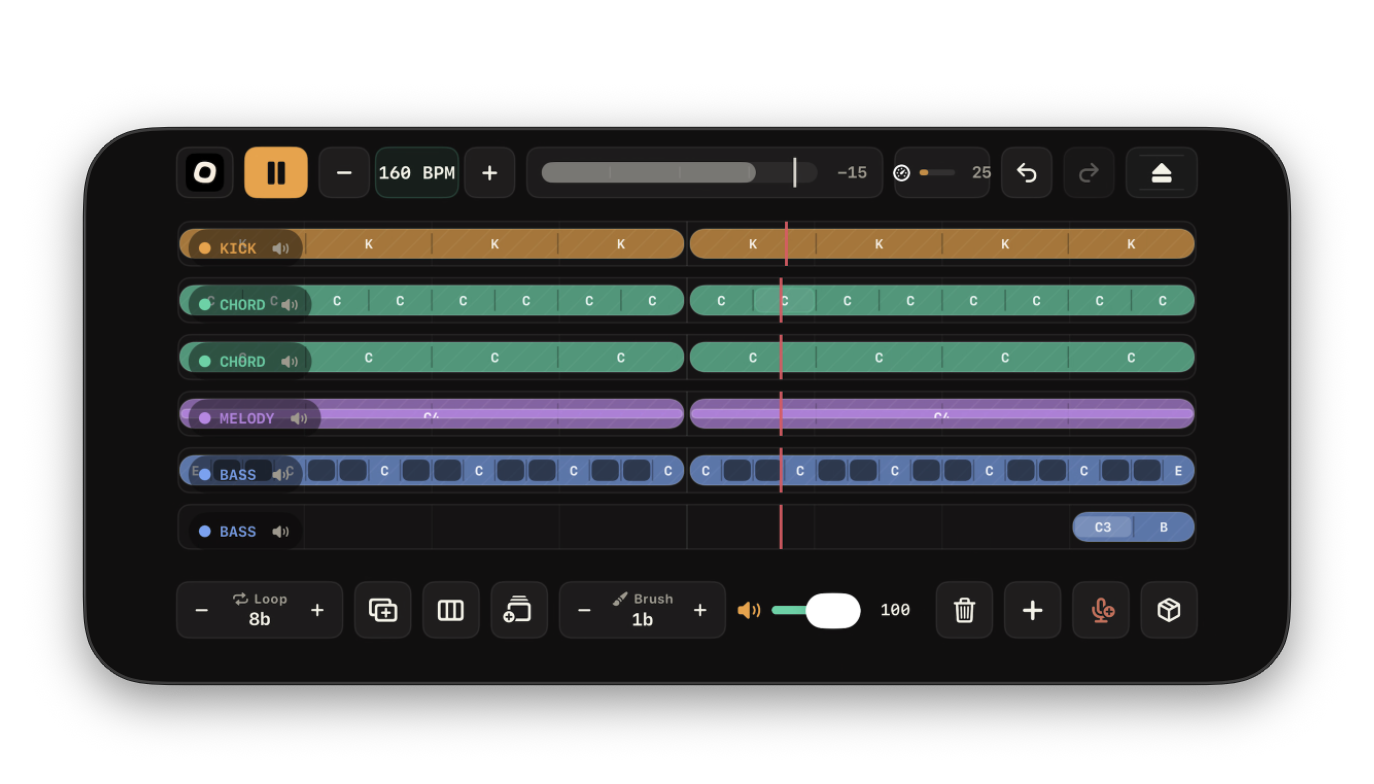
A friend got me Daphne Oram’s book. She developed the Oramics Machine, which synthesized sound from lines painted on glass and film strips. I found her writing about sound and music, and her spirit of innovation and curiosity, hugely inspiring. I also wanted to try building for iOS with agents, so I started making orphne.
It’s pretty magical being able to coordinate agents, have them work together to build and deploy to TestFlight, and install and test the updates, all from my phone.
I guess I ended up building loops to build loops to build loops.
A silent sketch: a drawn line becomes a lane in the loop. When the loop is ready, drag blocks to move them or their edges to resize. Hold then drag vertically to split; tap a hit to rest it, a dot to mute, or an empty lane to add a block. Keyboard: left and right select blocks, up and down split, Shift with left or right moves, brackets resize, M mutes, Space rests a hit, and A adds a lane. Escape clears selection; Tab leaves the loop.
iOS · Coming real soon